Conformity Vocabulary
Please note that this specification is suitable for pre-production pilot implementations.
Artifacts
Schema, Context and Sample
A complete conformity vocabulary is a single hierarchy rooted at a Conformity Scheme that embeds its versioned Profiles, each of which embeds its versioned Criterion. The JSON schema, JSON-LD context and a sample instance are maintained in this repository. The v0.8.0 artefacts are the working version, a candidate for UNTP v1.0.0.
- JSON Schema:
| Schema | Description | See also |
|---|---|---|
| ConformityScheme.json | Root schema for a conformity scheme including owner, scheme declaration, scoring framework, and the included profiles and their criterion | Candidate for UNTP v1.0.0 |
- JSON-LD Context:
| Context | Description | See also |
|---|---|---|
| untp-context.jsonld | The shared UNTP JSON-LD context that binds the vocabulary's terms to the UN/CEFACT vocabulary | Candidate for UNTP v1.0.0 |
- Sample Instance:
| Sample | Description | See also |
|---|---|---|
| ConformityScheme_instance.json | Minerals Assurance Scheme — benchmarked scheme, with its scheme declaration, containing the Tantalum Processor Standard profile with embedded due-diligence, mass-balance, and processor-input-controls criterion | Candidate for UNTP v1.0.0 |
The sample represents a minerals assurance scheme for responsible sourcing, with a tantalum processor profile and three representative criterion types.
Overview
Web vocabularies are a means to bring consistent meaning to conformity claims and assessments throughout transparent value chains, by ensuring that the standards used in claims and assessments are referenced as unique digital objects. Different participants will reference the same documentation in an identical, machine-recognisable, manner. Critically, this enables Product Passport claims to be verified against corresponding conformity credentials and to facilitate comparison among different conformity credentials
To achieve these outcomes, these digital objects need to be discoverable from a version-specific and persistent URI link. This specification provides instruction for conformity scheme owners about how to publish their schemes and associated criterion as linked data vocabularies so that they can be referenced by CABs in conformity credentials and by manufacturers in their Product Passport and Facility Record claims.
A key design principle is to keep the work of CABs and Manufacturers simple by pushing re-usable complexity to the scheme. For example, when a scheme owner is responsible for the deconstruction of their scheme into fine grained and categorised criterion then the criteria against which assessments are undertaken by CABs are made transparent through references within conformity credentials to the scheme vocabulary. Similarly, when scheme owners clearly reference all standards and regulations that their scheme is designed to meet then verifiers can easily assess whether a given conformity credential is sufficient to meet their regulatory compliance needs.
Conformity Vocabulary Catalog
UNTP will maintain a catalogue of schemes that are registered with UNTP by scheme owners that have implemented this specification. This provides an entry point for discovery of rich scheme data maintained consistently by multiple scheme owners.
- The first (current) version is the current Scheme Owners registration page.
- Before the first stable release of UNTP, the various registers (conformity schemes, identifier schemes, etc) will be published as machine readable and human readable structured linked data.
The scheme register is also a useful source of examples as each scheme publishes its conformity vocabulary.
Standards and Regulations
Some conformity schemes generate their own standards internally and these may be formally referenced according to the Logical Model defined for the scheme vocabulary. It is also common for conformity schemes to reference formal standards (eg from ISO,national standards bodies or other institutions), often with the intention to meet legal requirements of national regulators or international treaties.
Therefore part of this specification also includes mechanisms to reference both internally-generated standards and relevant externally-published standards and regulations. In either case, for these references to be stable, meaningful and consistent across schemes, the standards and regulations themselves also need globally unique URI identifiers.
- Most regulations are already published by nation states in a digitally referenceable way as stable URLs. For example the Australian National Greenhouse and Energy Reporting (NGER) regulation measurement standards are permanently referenceable at https://www.legislation.gov.au/F2008L02309
- However, it is less common for Standards Development Organisations (SDOs) to maintain their catalogue of standards as digitally referenceable objects with appropriate version control. However, where it can be established that an SDO does produce viable digital references then these SHOULD be used for the purposes of UNTP.
Conceptual Model
Diagram 1 shows how the Conformity Vocabulary works with UNTP credentials, such as Product Passports, Facility Records and Conformity Credentials, to bring unambiguous meaning to sustainability claims and assessments.
Diagram 1:
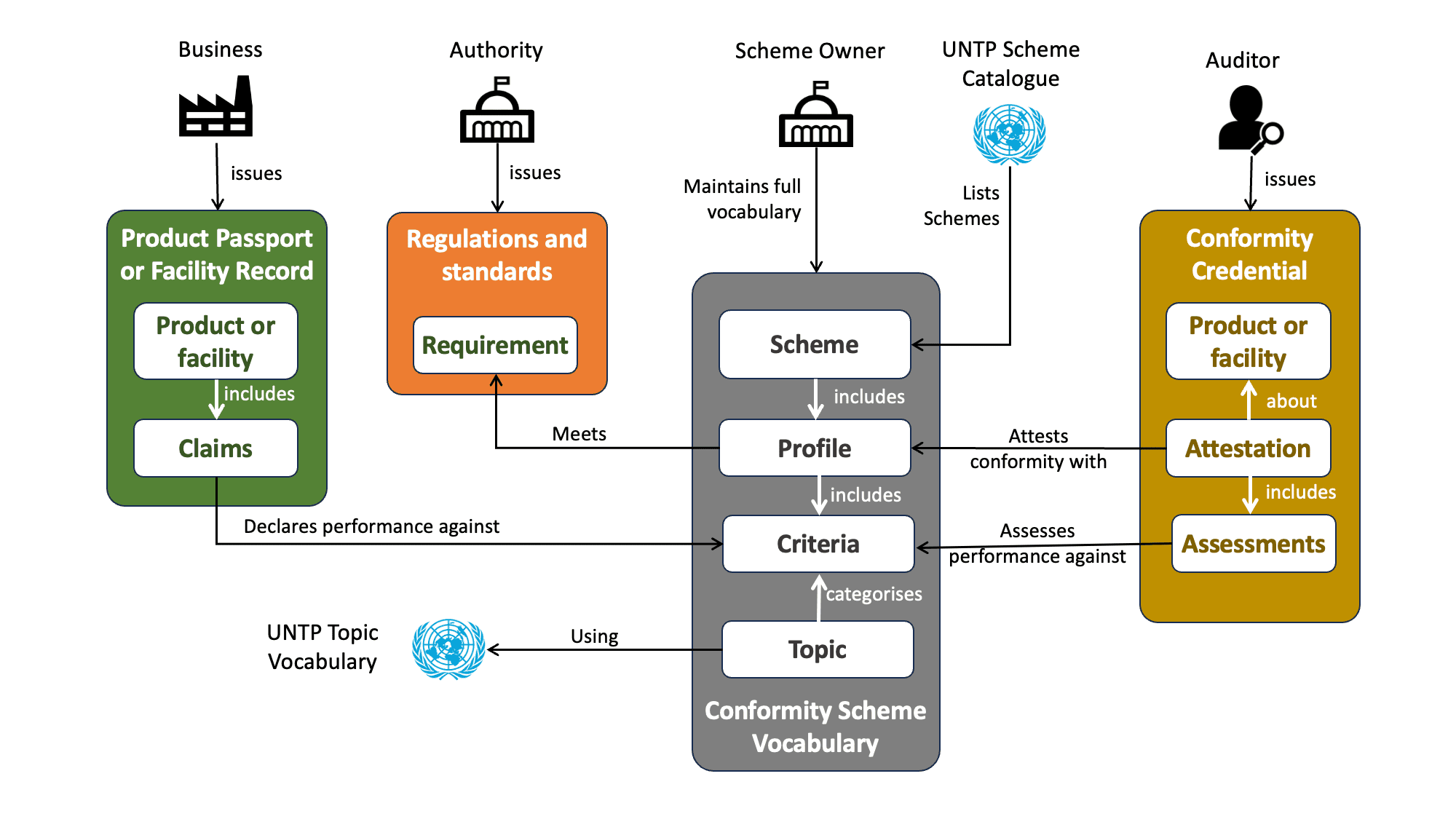
- Conformity Schemes (Grey) include one or more versioned profiles that are themselves composed from independently versioned criterion.
- A criterion is a versioned set of auditable requirements related to a specific conformity topic such as Forced Labour. It is identified and referenced by a URI such as
myscheme.org/criterion/forced-labour/1.0.0 - A profile is essentially a versioned description of the scheme, or subset of a scheme, in terms of a broad conformity outcome elements, without including details of the auditable criteria. It is identified and referenced by a URI such as
myscheme.org/profiles/mine-site/1.0.0It composes one or more versioned criterion (which contain the auditable criteria) to construct a high-level set of requirements against which a conformity attestation might be issued. A profile MAY additionally link to any external national regulations, international conventions, voluntary standards etc, to which it is aligned and for which it aims to assist compliance. - Criterion and profiles are independently versioned. That's because a profile (v1.0.0) might compose 20 criterion. An update to the profile (eg v1.1.0) might only change a couple of criterion with the rest unchanged.
- A criterion is a versioned set of auditable requirements related to a specific conformity topic such as Forced Labour. It is identified and referenced by a URI such as
- Product Passports and Facility Records (green): Manufacturer or brand owners issue Product Passports and Facility Records that include a series of performance claims. Each claim MAY reference one or more criterion published by a scheme owner so that the claim is unambiguously understood. Note that a single Product Passport or Facility Record MAY make claims that reference criterion from multiple different schemes.
- Conformity Credential (brown): The UNTP conformity credential provides a means for a conformity assessment body to list assessment outcomes for specific products or facilities against defined criteria. A Conformity Credential includes one
attestationthat maps to a Conformity Vocabularyprofileand multipleassessments, each of which map to a Conformity Vocabularycriterion - A Conformity Vocabulary profile should list the external national regulations, international conventions, and voluntary standards to which it is aligned and which it aims to assist compliance.
For a Conformity Credential to verifiably support a claim contained in a Product Passport or Facility Record, there SHOULD be matching of the criteria referenced in the Product Passport or Facility Record and the supporting credential. Where assessments are undertaken in accordance with a scheme for which a scheme vocabulary exists, the mechanism for achieving such matching is to use the same identifier for the scheme criteria within both the Conformity Credential and the Product Passport or Facility Record.
Any conformity scheme is associated with a unique versioned set of participation rules and other scheme-level information established by the scheme owner, meaning that concurrently-delivered schemes or profiles involving rule variants or other differences (such as endorsement coverage) MUST be registered as separate scheme vocabularies, even if owned and/or operated by the same entity. This is a different situation from where scheme rules may be updated but a transition period permitted, such that the validity of both versions may overlap for a period.
Requirements
| ID | Requirement Statement | Solution Mapping |
|---|---|---|
| CVC-01 | Scheme owners MUST publish the granular scheme criteria, potentially reflecting different sustainability attributes recognised within the scheme and potentially at varying performance levels, in such a way that each scheme criteria can be unambiguously referenced by issuers of conformity credentials, facility records, and product passports | Conformity Vocabulary Schema |
| CVC-02 | Scheme owners MUST manage versions of schemes to reflect changes in the criteria within a scheme so that claims and assessments can be understood within a specific version context | Conformity Vocabulary Schema |
| CVC-03 | Scheme owners are provided with guidance in establishing their vocabulary in accordance with the prescribed UNTP Schema. | Conformity Vocabulary Publishing Guide |
| CVC-04 | Scheme owner tag scheme criteria with context labels such as commodity type or facility type so that a relevant assessment can be identified for a given context. | Conformity Vocabulary Schema |
| CVC-05 | Conformity Assessment Bodies (CABs) have access to the URI associated with any scheme criteria so that these can be correctly referenced in the assessments recorded in digital conformity credentials. | Conformity Vocabulary Catalog |
| CVC-06 | Product suppliers or facility operators are provided with access tothe URI associated with any scheme criteria so that these can be correctly referenced in the claims recorded within product passports and facility records. | Conformity Vocabulary Catalog |
| CVC-07 | Given that there are hundreds of sustainability schemes, each with potentially hundreds of scheme criteria, consumers of digital credentials are provided with access to a classification for sustainability attributes to more easily compare assessments for a given sustainability attribute across different schemes. | Conformity Criteria Topic Classification |
| CVC-08 | Scheme owners MUST publish a scheme declaration as part of the scheme's conformity vocabulary, and it MUST be identifiable as current or lapsed | Scheme Declaration |
| CVC-09 | Every conformity scheme MUST publish a declaration, at every implementation maturity level | Scheme Declaration |
| CVC-10 | The declaration MUST address every process area, and an area that does not apply MUST be distinguishable from one that was not addressed | Scheme Declaration |
| CVC-11 | The declaration MUST identify what each process area aligns with, and the degree of that alignment | Scheme Declaration |
| CVC-12 | A consumer MUST be able to read what conformity assessment under the scheme must align with, and where parties other than the scheme owner may assess, the criteria those parties must satisfy | Scheme Declaration |
| CVC-13 | A consumer holding a Conformity Credential MUST be able to reach the declaration from the credential | Scheme Declaration |
| CVC-14 | A consumer MUST be able to distinguish a self-declared scheme from one holding authority recognition | Scheme Declaration |
| CVC-15 | A person with concerns about a scheme's adherence to its declared procedures MUST have somewhere to raise them | Scheme Declaration |
| CVC-16 | Declaration requirements MUST be able to tighten over time without breaking existing declarations | Scheme Declaration |
| CVC-17 | A consumer MUST NOT be able to mistake a self-declared alignment claim for an independently verified one | Scheme Declaration |
| CVC-18 | Each conformity profile MUST declare the object of conformity assessment it applies to (product, facility, or organisation) | Logical Model |
| CVC-19 | Each conformity profile MUST declare whether and how its listed criteria are mandatory, so that a consumer is not misled by criteria that a profile pass does not require | Optional Criteria |
Conformity Vocabulary Schema
This conformity vocabulary publishing guide provides scheme owners with a best practice framework that can be used to publish their schemes as a structured set of criteria, each with a unique identifier (URI) and with rich metadata about each criteria (eg topic classification, regulatory alignment, performance thresholds, etc). This is a critical activity so that issuers of product passports, conformity credentials, and facility records, can unambiguously reference a scheme and it's criteria.
Implementation Maturity Levels
This specification defines a very rich model for conformity schemes that will maximise the value that schemes can offer to their users. Full implementation may take scheme owners some time and so UNTP facilitates a phased implementation by defining a maturity model that allows implementers to start simple.
- Level 1 - Scheme only: At a minimum, scheme owners specify a permanent ID (As a URL) for each scheme version that they manage (eg
scheme.company.com/standard-a/1.8.0) including scheme level metadata such as the scheme declaration, which every scheme publishes at every maturity level, and any authority recognition it holds. This provides issuers of Conformity Credentials with an unambiguous scheme reference but does not break down the scheme into meaningful components. - Level 2 - Scheme & criteria : Scheme owners publish both their versioned schemes and versioned criterion as permanent URLs. Each criterion is also classified by UNTP conformity topic code. This provides supply chain actors facing multiple claims against multiple schemes with an easy way to make sense of the scope of conformity claims and assessments.
- Level 3 - Full vocabulary: Scheme and criteria are published with full metadata as well as performance thresholds and standard / regulatory alignment mappings. Assessments based on such schemes provide supply chain actors with the most complete and comparable compliance map.
Logical Model
This section describes the detailed logical data model of a conformity scheme vocabulary. The diagram below shows a Conformity Scheme and the components it composes — its scheme declaration, its versioned profiles, and the criteria within them.
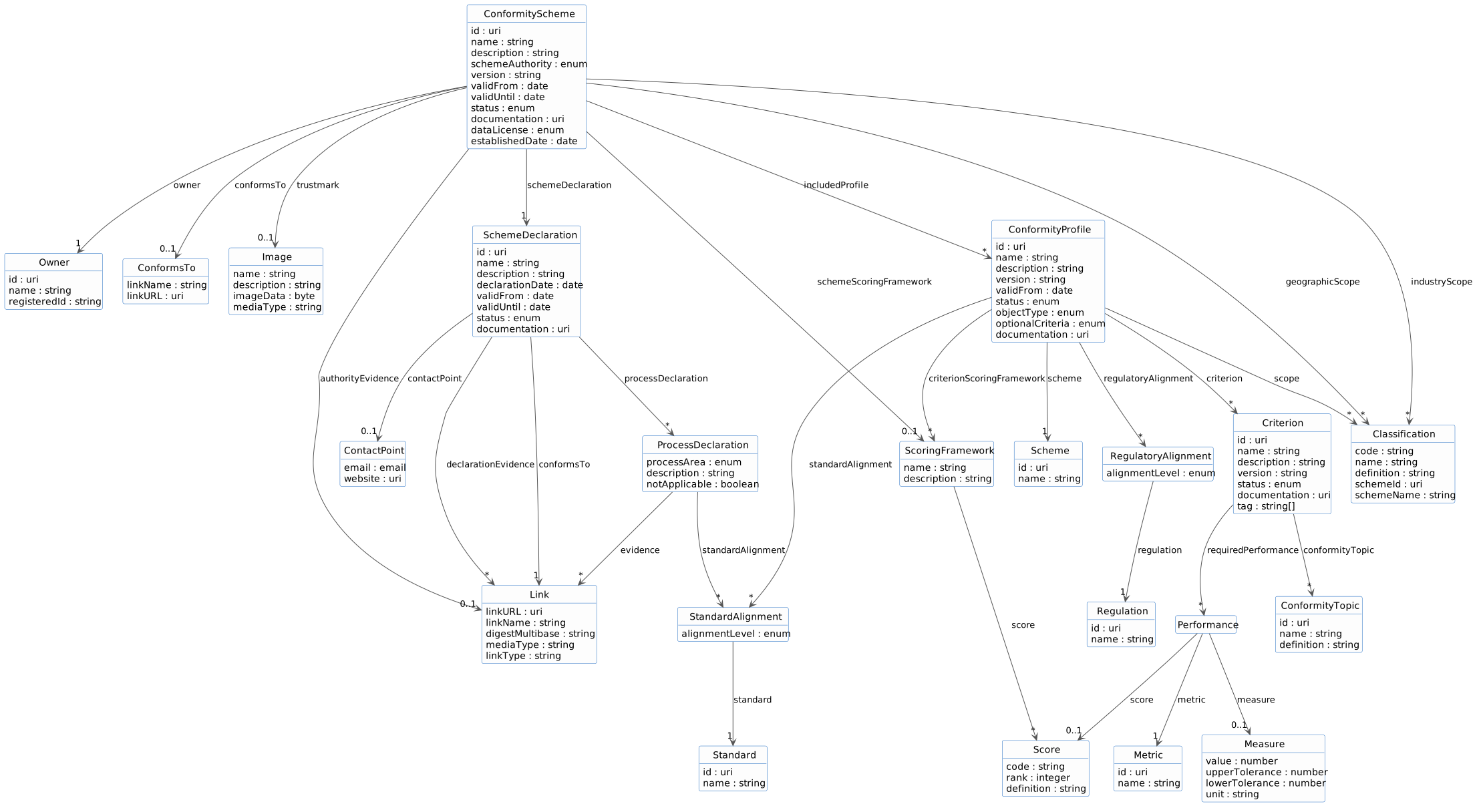
Read it top-down. A ConformityScheme publishes a SchemeDeclaration and one or more versioned ConformityProfiles; each profile composes one or more versioned Criterion, and a criterion may carry a required Performance and a conformityTopic. Each box is an object; each labelled arrow is a property, with its cardinality (1, 0..1, *) at the target end.
The key ideas in the logical model of a published conformity vocabulary are
- A conformity scheme MUST have a unique ID, a version, a validity period, an owner, a scheme declaration, and references one or more versioned scheme profiles. It MAY additionally record authority recognition.
- The conformity scheme MAY define performance levels against which criteria can be categorised. It may also define an allowed set of tags which can be assigned to criteria for the purposes of filtering or sorting.
- Scheme profile matches the scope of an audit under the scheme. Many schemes maintain different scoped profiles for different facility types (eg smelter, mine-site, etc), commodity types (eg cotton, copper, etc), or conformity topic (forced labour, emissions, etc). Each profile composes one or more versioned assessment criterion.
- Conformity profiles MAY define alignment (for example, partial, meets, exceeds) against any regulations or standards.
- A conformity profile MUST declare its
objectType— the object of conformity assessment it applies to (product,facility, ororganisation), aligned with the "object of conformity assessment" defined in ISO/IEC 17000:2020. - A conformity profile MUST declare
optionalCriteria— whether and how its listed criteria are mandatory for a profile-level pass — so that a consumer is not misled by a list of criteria that a pass does not actually require (see Optional Criteria). - A criterion MUST have a unique ID (a URI) which is the key reference for any claims or assessments of product or facilities made in product passports or conformity credentials.
- Each criterion SHOULD be classified according to the applicable UNTP Conformity Topic Code.
- A scheme criterion MAY specify a required performance threshold as a numeric (eg 300Mpa tensile strength) or a score (eg "B") which an assessed product or facility much achieve in order to be considered conformant.
- A scheme criterion MAY be classified according to formal classification schemes (eg applicable industry sector or commodity type).
- A given scheme criterion ID MAY be re-used by multiple Profile ID (for example a Scheme version increments but most of the conformity criteria don't change from one version to the next).
Conformity Scheme Schema
The full JSON Schema for a conformity scheme is the working version, a candidate for UNTP v1.0.0.
Scheme Declaration
Every conformity scheme MUST publish a schemeDeclaration — a first-party statement by the scheme owner describing how the scheme is governed, developed and delivered, with reference to applicable international standards. Its object is the scheme itself, so it is distinct from a Conformity Attestation of type declaration (a statement about an assessed object). It is published unconditionally: at every maturity level, whatever authority recognition the scheme holds.
A declaration MUST address each of the five process areas, given by the SchemeProcessArea code list:
| Value | Process area |
|---|---|
scheme-governance | Scheme Governance |
scheme-development | Development of Scheme |
standards-development | Standards Development |
personnel-competency | Competency of Personnel |
conformity-assessment | Conformity Assessment |
Each entry is a ProcessDeclaration carrying a description, its standard alignments and degree of alignment, and supporting evidence; more than one entry MAY cover the same area with distinct scopes. An area that genuinely does not apply is declared with notApplicable: true and the reason in description, so an exemption is distinguishable from an omission (for example a government-mandated scheme, with the mandate recorded in schemeAuthority + authorityEvidence). The conformity-assessment entry states what assessment under the scheme must align with; where parties other than the owner may assess, its evidence MUST include the criteria they must satisfy. It is not a register of licensed assessors — those are published as Digital Identity Anchors.
Self-declaration is read from the presence of the declaration together with the absence of schemeAuthority; there is no self-declaration code value. The alignment levels asserted are unverified first-party claims until confirmed via the evidence / declarationEvidence links — meets against a standard is the owner's assertion, not accreditation. Renderers SHOULD present the authority pathway as a fact rather than a rank (the pathways are deliberately non-hierarchical) and make clear that alignment levels are self-asserted.
Optional Criteria
A profile that lists many criteria can give a false impression of rigour if a profile-level pass does not in fact require every listed criterion to be assessed and passed. To make this transparent at the top level, every conformity profile MUST declare optionalCriteria, drawn from the following code list:
| Value | Meaning |
|---|---|
all-mandatory | All listed criteria must be addressed in full for compliance to be achieved. |
minimum-thresholds | Minimum compliance thresholds apply, such that not every aspect of a given criterion need be addressed in full. |
alternative-pathways | Alternative pathways to compliance exist, such that not all criteria need to be addressed. |
see-scoring-framework | Refer to the profile's scoring framework for the detail. |
Where the value is anything other than all-mandatory, a consumer is warned that a profile pass may not require every listed criterion, and SHOULD consult the profile's scoring framework to understand what a pass entails.
Conformity Topic Codes
UNTP defines a standard taxonomy of conformity topics which SHOULD be used to classify criterion so that criterion across multiple schemes can be aligned around common topics such as forced labour, emissions, water usage, safety, etc. Please refer to conformity topics for further details.