Technical Specifications
Please note that this specification is suitable for pre-production pilot implementations.
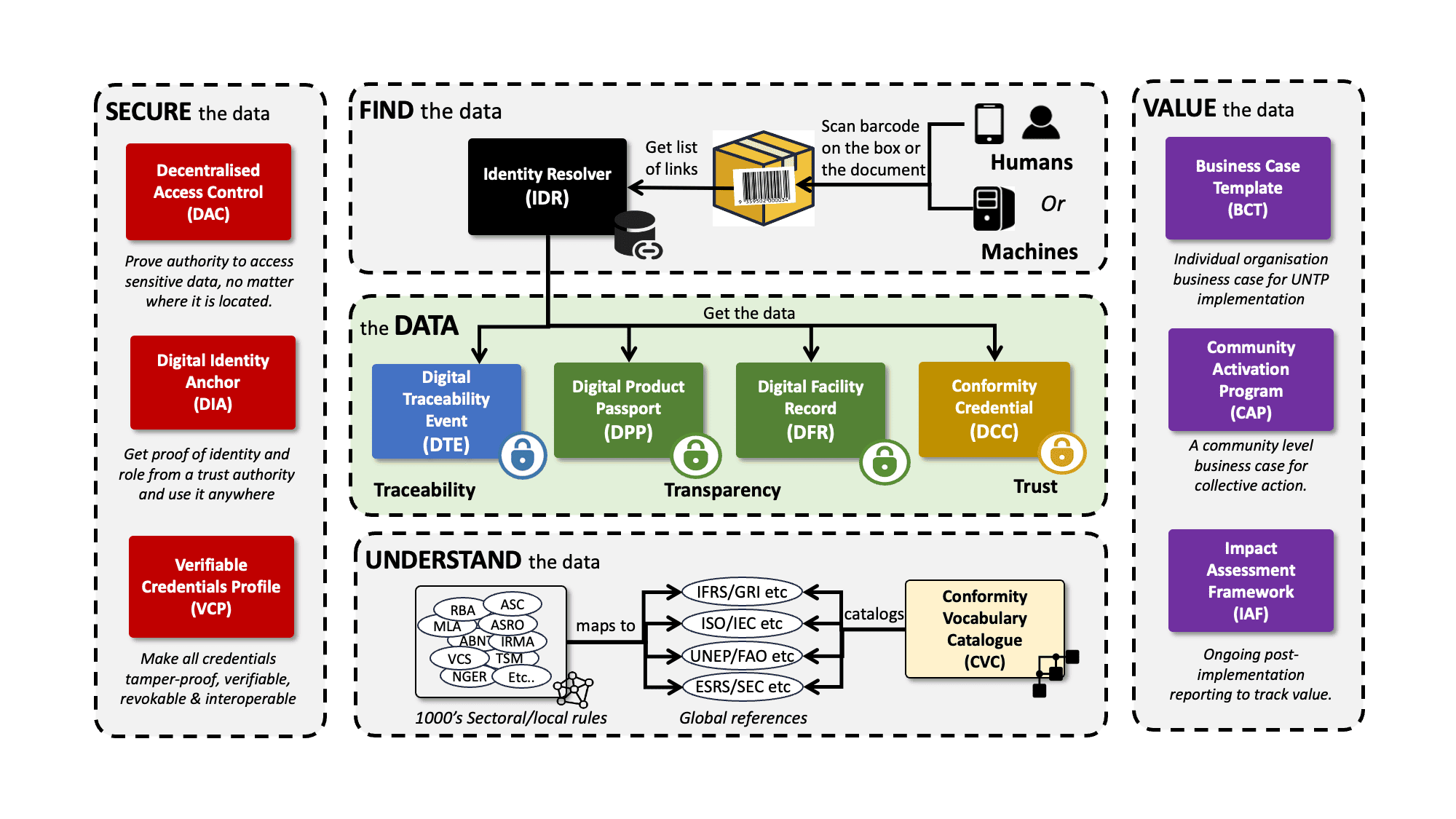
The UNTP specification defines a suite of interoperable digital credentials and discovery mechanisms that, together, enable verifiable supply chain transparency at scale. Each credential type is independently implementable and targeted at a specific supply chain role, but the real value emerges when multiple actors across a value chain each play their part — creating a connected graph of verifiable data that supports automated compliance assessment without any central authority or data store.
Requirement keywords
The key words "MUST", "MUST NOT", "REQUIRED", "SHALL", "SHALL NOT", "SHOULD", "SHOULD NOT", "RECOMMENDED", "NOT RECOMMENDED", "MAY", and "OPTIONAL" in the UNTP technical specifications are to be interpreted as described in IETF RFC 2119 and IETF RFC 8174 (BCP 14) when, and only when, they appear in all capitals, as shown here. Lowercase uses of these words have their ordinary English meaning.
This interpretation applies to all pages under Technical Specifications.
Authenticity and auditability
Digital signatures provide assurance of credential integrity and issuer authenticity. Some implementations may additionally use transparency mechanisms that provide verifiable inclusion proofs or append-only audit logs. These mechanisms enable relying parties to validate not only credential authenticity but also the completeness and history of published data. Such mechanisms are implementation-specific and are not required for UNTP conformance.
Further detail is in the Verifiable Credentials Profile.
Diagrams and UML notation
Logical model diagrams in the UNTP technical specifications that use class-diagram notation (including Mermaid classDiagram figures such as the Core Vocabulary overview) are drawn using Unified Modeling Language (UML) conventions. Diagram notation SHOULD be interpreted in accordance with OMG UML 2.5.1. For example, a solid filled diamond denotes UML composition (a whole–part relationship).
Unless a specific figure is explicitly labelled as normative, diagrams are informative. They illustrate structure for human readers. If a diagram conflicts with normative prose, requirement tables, JSON Schema, JSON-LD contexts, or the ontology, those textual and machine-readable artefacts take precedence.
Credential Specifications
For Producers and Manufacturers
Producers and manufacturers integrate DPP, DFR, and DTE credentials into their existing production management and ERP systems — either by building their own integration or because their business software provider has implemented UNTP credential support.
The Digital Product Passport (DPP) is issued by the shipper of goods and carries product identity, characteristics, and sustainability performance data for serialised products or product batches. It is deliberately lightweight, designed to carry the minimum data needed by downstream receivers — such as scope 3 emissions intensity or deforestation-free status — while linking to conformity credentials for independent verification and traceability events for supply chain visibility.
The Digital Facility Record (DFR) is issued by facility owners or operators and describes facility identity, location, ownership, and sustainability performance over defined reporting periods. Facilities typically hold multiple identifiers from different authorities, and the DFR allows each to resolve to the same authoritative facility record via the identity resolver infrastructure.
The Digital Traceability Event (DTE) records the lifecycle activities of products as lightweight verifiable credentials capturing the what, when, where, who, and how of supply chain events. Three event types — make, move, and modify — model any supply chain activity, enabling facility-level mass-balance assessment and full upstream traceability when linked to DPPs.
For Conformity Scheme Owners
The Conformity Vocabulary Catalog (CVC) enables scheme owners and regulators to publish their rules, criteria, and scoring frameworks as machine-readable linked data vocabularies. When conformity criteria are published as unique digital objects, DPP claims can be unambiguously verified against conformity credentials and compared across different schemes — pushing complexity to scheme owners so that manufacturers and conformity assessment bodies have simpler, more consistent work.
For Conformity Assessment Bodies
The Conformity Credential is issued by conformity assessment bodies (CABs) and provides independent, digitally verifiable assessments of products, facilities, or organisations against published standards and regulations. Each credential carries the assessor's accreditation, the reference scheme and profile, measured performance metrics, and a conformance determination — giving downstream verifiers high-confidence evidence to support the claims made in product passports and facility records.
For Identifier Registers
The Identity Resolver (IDR) defines how existing identifier systems — business registers, product registries, facility cadastres — participate in a consistent discover-resolve-verify workflow. UNTP does not replace existing identifiers but builds upon them, enabling any identifier (whether registry-managed or self-issued as a DID) to resolve to verifiable data such as product passports, facility records, and conformity credentials.
For Identity Authorities
The Digital Identity Anchor (DIA) is issued by authoritative registers — national business registers, trademark offices, mining cadastres, accreditation bodies — and provides a digitally verifiable binding between a decentralised identifier (DID) and an authoritative registered identity. The DIA allows verifiers to confirm not only that a credential was issued by the controller of a DID, but that the DID controller is the genuine holder of a registered identity.
The Digital Corporate Record (DCR) describes a legal entity — the company behind the facilities and products — including the facilities it operates, the entities it owns or is owned by, and the claims it makes at corporate level. It is typically issued by a business register or an accredited data provider, and complements the DIA: the anchor binds an identifier to a registered entity, while the corporate record describes that entity. Its scope is still under review.
Foundational Components
The following specifications provide the shared technical foundations and semantic building blocks used across all UNTP credential types.
The Verifiable Credentials Profile (VCP) specifies the W3C Verifiable Credentials and DID standards that underpin all UNTP credentials, ensuring that every credential is digitally signed, tamper-evident, revocable, and independently verifiable.
The Decentralised Access Control (DAC) specification defines patterns for balancing transparency with confidentiality. It provides six progressively stronger access control patterns — from anonymous public access through to decentralised authentication — that can be applied independently or in combination to meet each actor's data-sharing policies.
The Core Vocabulary defines the shared classes and properties — such as Product, Facility, Party, Attestation, and Assessment — that are reused across all UNTP credential types, ensuring consistent semantics and interoperability.
The Core Taxonomies provide standardised classification schemes for conformity topics (what is being assessed) and performance metrics (how performance is measured), enabling automated comparison and aggregation of sustainability data across credentials and value chains.
Beyond the Specification
The specification is the technical core of UNTP, but successful adoption depends on broader context. The following sections of this site provide complementary guidance.
- Governance — How the UNTP is developed, maintained, and versioned through an open, consensus-driven process.
- Best Practices — Solutions for common supply chain challenges including transparency graphs, graph validation, and chain-of-custody mass-balance allocation. Graph validation examples are informative and post 1.0; they are not part of this specification.
- Business Case — The value proposition for industry and government, including cost-benefit analysis and adoption incentives.
- Tools and Support — Implementation guidance including how to test and verify your UNTP implementation.
- Implementations — Registers of software providers, industry pilots, conformity schemes, identity registers, and other implementers — and how to register your own implementation.