Governance
Please note that this specification is suitable for pre-production pilot implementations.
The UNTP governance framework follows UN/CEFACT standard governance methodology and is designed to provide implementers with confidence that UNTP:
- is a public good that cannot be captured by any specific commercial interest and is permanently free to use.
- is developed via a consensus based process that ensures it will meet the needs of value chain actors and member states.
- is specific, testable, and rigorously versioned so that implementers can be confident of stability and interoperability.
- is compatible with relevant national and international standards and regulations.
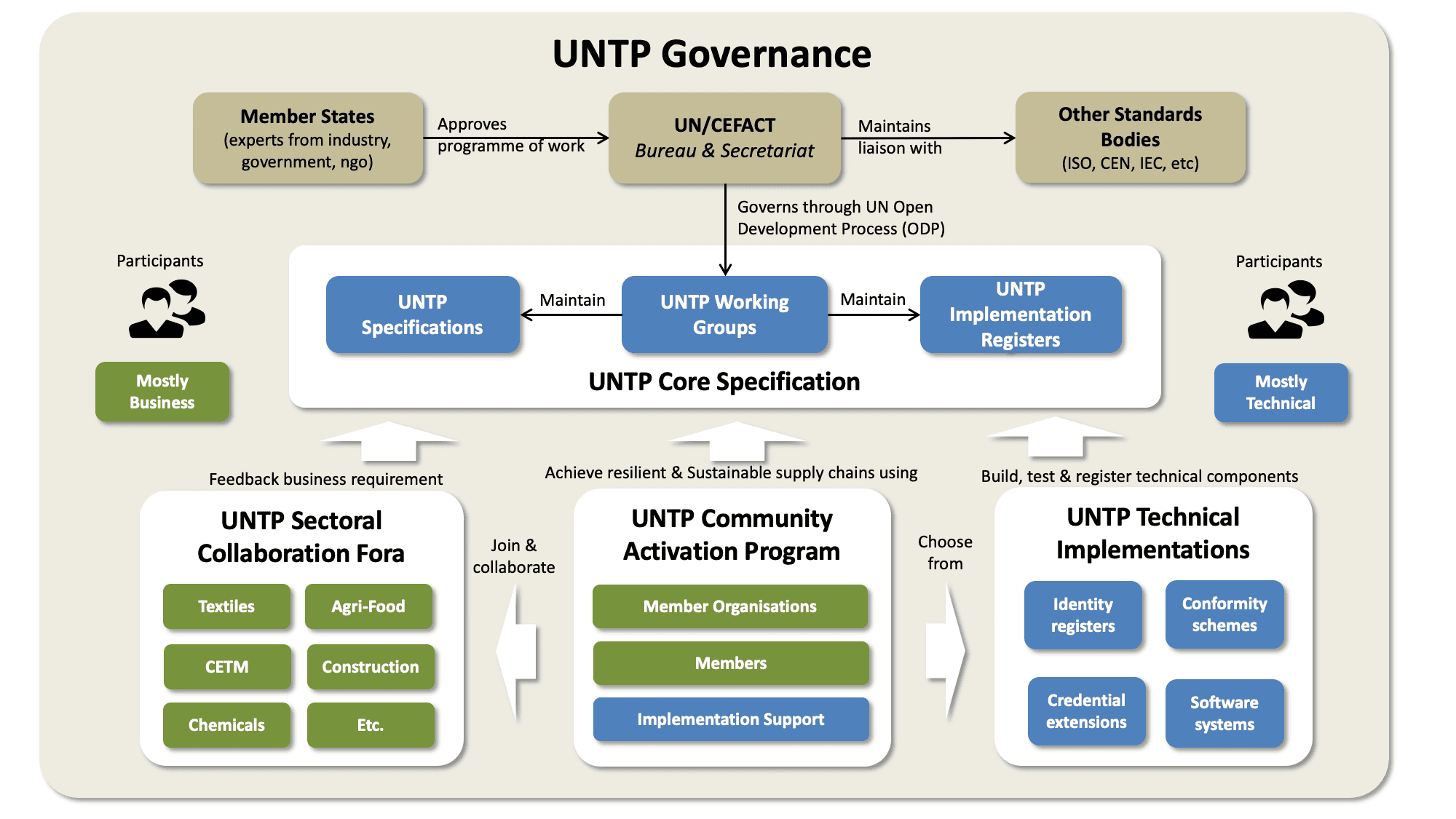
The governance framework covers four distinct domains.
UNTP Core Specification
How the UNTP specification itself is developed, maintained, and versioned as a UN standard — including the UN/CEFACT framework, working groups, participation rules, change management process, and version management.
UNTP Technical Implementations Register
UNTP adoption depends on technical implementations by Identifier registers, conformity schemes, credential extensions, and software systems. This is the bottom-up process by which individual implementations earn registration by building conformant implementations, passing tests and providing evidence.
UNTP Sectoral Collaboration Fora
How communities working in the same sector or jurisdiction collaborate on harmonisation, re-use, and the sharing of lessons across multiple UNTP extensions and implementations. This is the top-down process that complements implementation governance — ensuring that technically interoperable implementations also converge on shared semantics and best practices through sectoral fora.
UNTP Community Activation Program
The Community Activation Program (CAP) provides a methodology and business case for member organisations to drive collective UNTP adoption across their membership. Communities choose from registered technical components — identity registers, conformity schemes, credential extensions, and software systems — to accelerate interoperable implementation, and join sectoral fora to facilitate collaboration and harmonisation across their industry.
The UNTP Implementation Governance Tree
A scalable, interoperable supply chain transparency framework has to work across every industry sector and jurisdiction, accommodate each sector's specific needs, empower existing communities rather than replacing them, and share reusable technical components (for example software platforms) across multiple sectors and geographies.
The best way to explain the UNTP approach is an analogy to a tree.
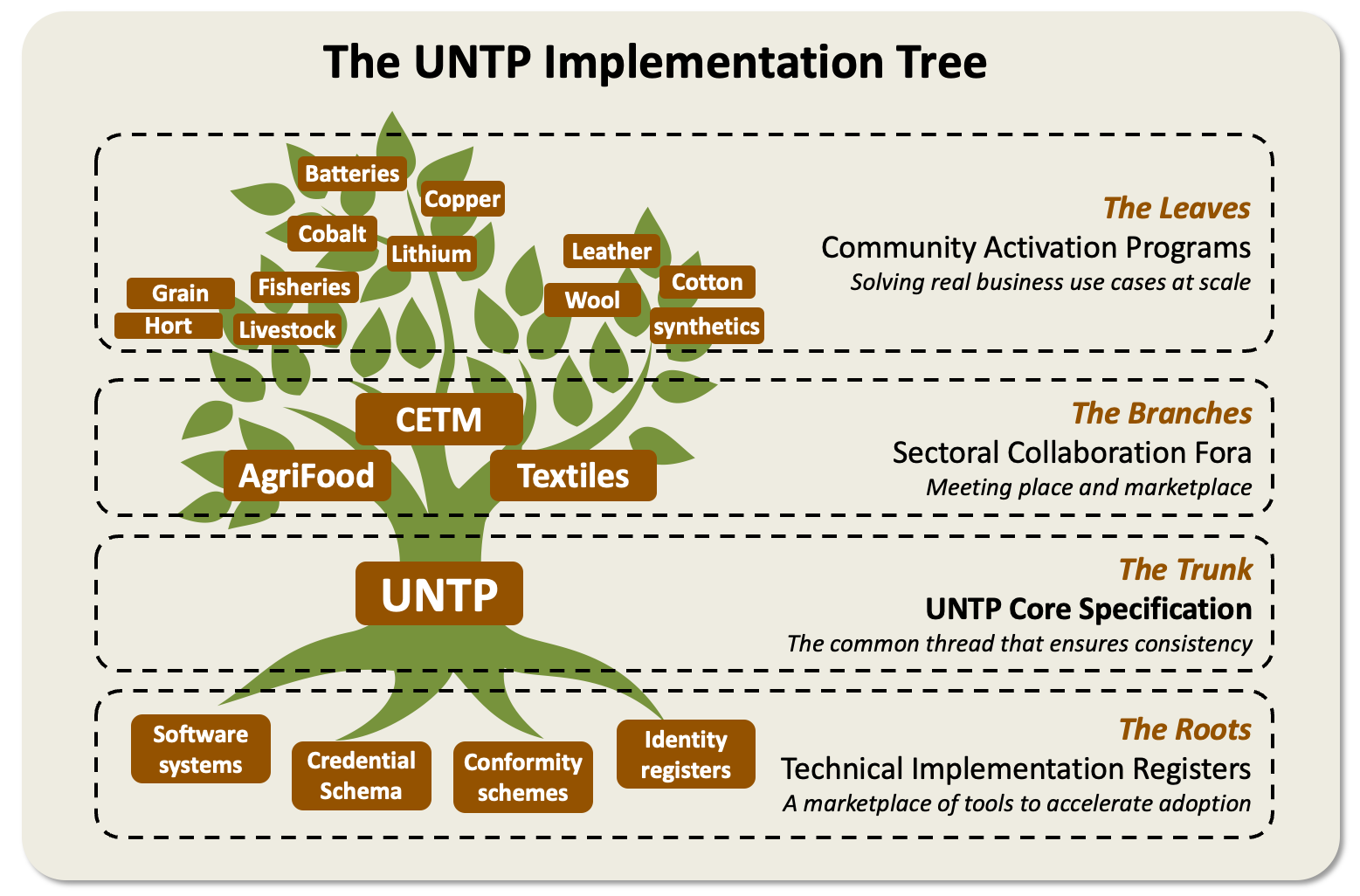
- There is just one tree trunk, representing the UNTP core specification. Every implementation — whether in the branches above or the roots below — is interoperable with every other because all of them build on this common core.
- A small number of branches represent very broad industry sectors such as Critical Energy Transition Materials (CETM). The UN provides a collaboration forum for implementation communities within each sector to meet, share knowledge, and where relevant build consensus.
- The leaves are where the action happens. They represent existing community groups such as industry member associations who define the use cases and specific UNTP extensions that are needed to meet their member needs.
- The roots represent registered (and tested) technical tools and services such as software platforms and identity registers that will often be used in many different communities. So the leaves can draw upon any of the roots.
The implementation pathway for any specific actor is therefore to look for the relevant sectoral forum (a branch), find an existing community that matches their needs (or launch one with their preferred member association if there's nothing ready to go), and then use any of the tested tools that match their system requirements (or push their preferred software vendor to implement UNTP). In this way there is maximum flexibility, empowerment, and re-use of existing work. It's the fastest and simplest pathway to genuine global supply chain transparency.
Data governance and responsibility
UNTP is a decentralised protocol. There is no central UNTP database: every credential is published by the party that issues it, hosted where that party chooses, and verified cryptographically by whoever receives it. Responsibility for the data therefore follows the role each party plays, not a central operator.
| Role | Responsible for | Where this is defined |
|---|---|---|
| Credential issuers (producers, conformity assessment bodies, registrars) | The content and accuracy of the claims they sign. A verified signature proves who made a claim — it does not prove the claim is true. | Verifiable Credentials profile |
| Software implementers | The technical conformance of the credentials their products issue, continuously observed in production. | SWI register |
| Extension and scheme owners | The schemas, JSON-LD contexts, and vocabularies they publish, and their stability at registered URLs. | Registers architecture |
| Hosting platforms | The availability of hosted credentials on the retention terms they publish, including notice and export before data is rendered inaccessible. | Durable Storage |
| Communities and jurisdictions | Retention scope, recognition of schemes across borders, and legal recourse against misleading or fraudulent data under applicable law. | Sovereignty and Jurisdiction |
| UNECE | Maintaining the specification and operating the registers and registrar agent, which record signed, machine-verified conformance observations. | Specification development, Registers architecture |
Two boundaries follow from this allocation and are worth stating plainly:
- The United Nations is not responsible for data published by implementers. The UN maintains the protocol; it does not author, verify the truth of, or endorse the content of any credential issued under it, and it is not responsible for failures or defects in any implementation. The legal form of this position is in the site Terms and Conditions.
- Appearing in a UNTP register is not an endorsement. Register entries record observed technical conformance at the time of the last observation — nothing more. What registration does and does not mean, and how status is gained and lost, is covered in the registers architecture.