Different Digital Maturities
Please note that this specification is suitable for pre-production pilot implementations.
Overview
The world will not transition from paper to digital overnight. For years — possibly decades — supply chains will operate with a mix of PDF documents, paper certificates, and digitally verifiable credentials. Every UNTP implementer faces the same reality: some upstream suppliers are not yet issuing verifiable digital data, and some downstream customers are not yet equipped to consume it. This page describes the challenges of this transition period and the UNTP design patterns that address them.
For guidance on entry points suited to actors who are not yet ready to issue credentials directly — including credential consumer, community activation, and delegated issuance patterns — see Low Digital Maturity Organisations in the Implementation Guidance.
Challenges
Upstream: Unstructured Input Data
Most supply chain actors will encounter upstream suppliers that have not yet implemented UNTP. Their product and facility data arrives as PDF documents, scanned certificates, spreadsheets, or even paper records. This creates several problems for an implementer trying to build a transparency graph:
- No machine-readable structure — the data cannot be automatically loaded into a graph database or validated against business rules.
- No cryptographic integrity — PDF documents and paper certificates are trivially easy to fake with modern AI tools. There is no digital signature to verify authenticity.
- No consistent discovery — unlike UNTP credentials that are discoverable via identity resolvers, unstructured data arrives through ad-hoc channels (email, portals, physical mail) with no standardised way to check for updates.
- No entity linking — a PDF certificate might refer to "Copper mining facility seven" while the graph knows the same facility as ID
https://someregister/facilities/5558880000030. Without structured identifiers, linking data across credentials is manual and error-prone.
Downstream: Customers Not Ready for Digital
At the other end, an implementer that issues UNTP digital credentials may find that some customers cannot process them. A small retailer scanning a QR code on a product expects to see something human-readable — not a JSON-LD document. If digital credentials are only machine-readable, they create a barrier to adoption rather than removing one. The challenge is to issue credentials that serve both technically advanced verifiers running automated compliance checks and less technical actors who need a simple, readable document.
Solution
Ingesting Unstructured Data with AI
For upstream suppliers that have not yet implemented UNTP, the recommended approach is to use AI (Large Language Models) to transform unstructured data into graph-compatible linked data — but to flag that data as unverified.
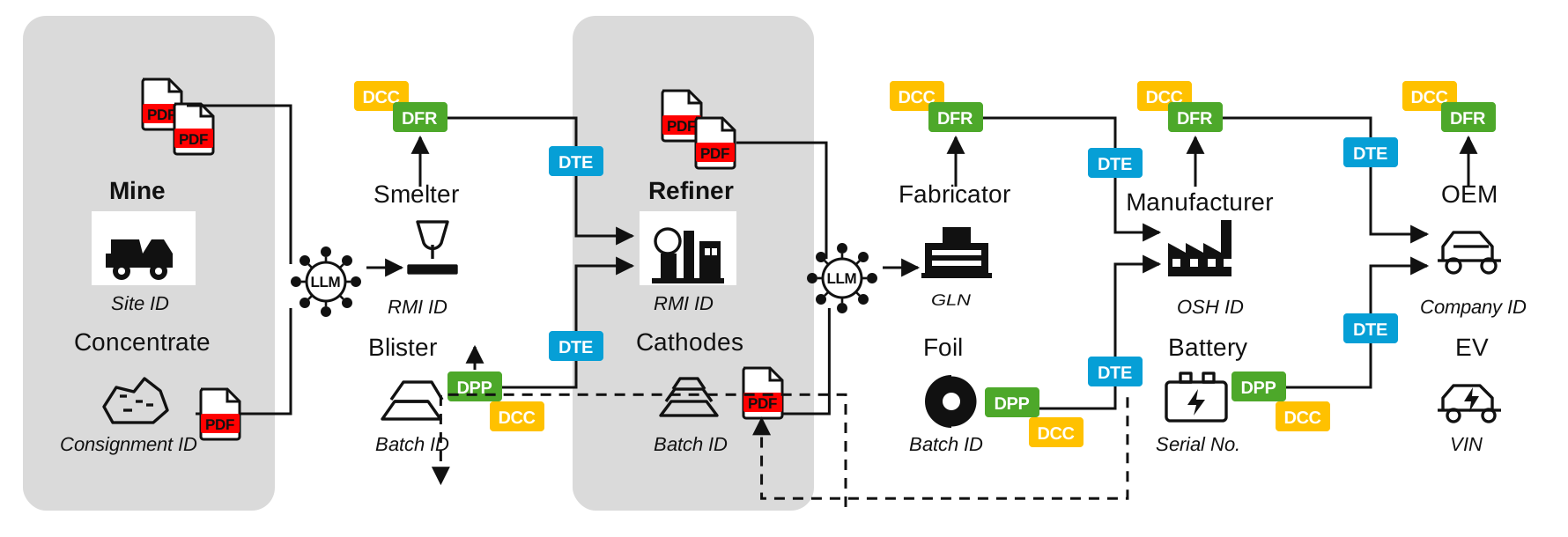
The diagram shows a case where the mine-site and the refiner have not implemented UNTP and are producing PDF documentation. The smelter and fabricator use an LLM to transform the PDF data into UNTP-structured linked data before loading it into their transparency graph. This means the same algorithmic assessments and validation rules can run across the entire graph, but portions derived from unstructured sources will be marked as lower integrity — warranting sample-based human review or traditional auditing.
There are important considerations for this approach:
- Entity matching — UNTP depends on globally unique identifiers to link data. A PDF document might refer to a facility by a different name than the graph uses. LLMs are well suited to matching similar entities, so implementers should follow GraphRAG best practices: first ask the LLM to extract and match entities against existing graph nodes, then transform the data using matched identifiers.
- Discovery — The Identity Resolver need not be limited to discovering UNTP credentials. It can also make PDF product or facility data consistently discoverable. Even before implementing UNTP credentials, there is value in making existing data discoverable via an identity resolver — this standardises how downstream actors find and refresh your data.
- Integrity — AI cannot generate valid cryptographic signatures. Unstructured data ingested via LLM should be treated as unverified and clearly flagged in the graph. Implementers should plan to transition suppliers from PDF documents to digitally signed credentials over time.
In the diagram above, the mine-site passes unstructured data to the smelter via an unmanaged channel, so the smelter must manually request updates and cannot be sure the data is genuine. However the refiner, although still exchanging unstructured data, publishes it through an identity resolver — so the fabricator can be confident it is genuine refiner data and can automate the discovery and update process.
Evidence Across a Change of Medium
Flagging ingested data as unverified raises a further question: how does a downstream verifier know what any particular piece of evidence is worth? A conformity credential derived from a scanned paper certificate may be technically valid and still be evidentiarily thin, and a verifier that cannot tell the difference will either trust too much or trust nothing. UNCITRAL's Model Law on Electronic Transferable Records treats this as a change of medium, where functional equivalence requires the integrity and reliability of a record to survive the transition.
UNTP does not carry a self-declared evidence tier or confidence value. Any such value is the issuer's own opinion of the issuer's own evidence. Whoever attaches a PDF can label it verified as easily as unverified, so the field would add an assertion without adding assurance, and the actors most likely to mislabel are the ones it is meant to expose.
Evidence strength is derived by the verifier instead, by following the evidence link and seeing what is there:
| Strength | How a verifier determines it |
|---|---|
| None | The claim carries no evidence link. It is an unsupported assertion. |
| Unverified | The link resolves to a non-verifiable artefact such as a PDF, a scan or an image. The link's mediaType says which. |
| Verified | The link resolves to a verifiable credential whose proof checks out. |
This test is available to every verifier today, it cannot be gamed by the issuer, and it produces an answer the verifier can stand behind. The interesting question sits beyond the third tier and is also derived rather than asserted: who issued that credential, is the issuer anchored by a Digital Identity Anchor, is the conformity scheme catalogued in the Conformity Vocabulary Catalogue, and is the assessor accredited for the scope it assessed.
An issuer supports the test by describing its evidence accurately:
- Attach what you have. A PDF is worth more than nothing, because it gives a verifier something to assess and a human something to read.
- Record what the artefact is.
mediaTypecarries the media type, so a paper-originated PDF is visibly a PDF rather than being passed off as structured data.linkTypecarries the business class of the document. - Include a digest.
digestMultibasebinds those exact bytes to the claim, so a digitised artefact cannot be swapped for a different one after the fact. This is what preserves integrity across the change of medium. - Prefer a credential where one exists. If the certifier already issues a Digital Conformity Credential, link to that rather than to a PDF rendering of it.
Where a party attests to the act of digitisation itself, saying that a particular scan is a true copy of a particular paper original, that is an attestation by an identified party and belongs in a conformity credential of its own. It is not a property of the claim it supports, because the claim's issuer is usually not the party whose word gives the attestation its value.
Carry the distinction through, do not collapse it. A consuming system that ingests a transparency graph should keep the derived strength attached to each claim and expose it in whatever assessment it produces. The failure mode this guards against is an automated compliance check treating an AI-ingested PDF value as equivalent to a verified credential, and reporting a confident pass built on an unverified input. A graph that records which portions came from unstructured sources can target sample-based human review at exactly those portions, which is the point of flagging them at all.
When AI Assists an Assessment
The section above covers AI transforming unstructured data. The harder case is AI taking part in a judgement: classifying a product, scoring a risk, pre-assessing conformity against a scheme, or flagging an exception. These have regulatory and commercial consequences, and the question implementers ask is how a credential should record that a model was involved.
It should not, and there is no field for it. UNTP does not distinguish a claim written by a person from one produced by a model, because the distinction a verifier needs is a different one: who is accountable for the statement. A credential is signed by an identified issuer, and that issuer carries what it signed however the content was arrived at. An AI-assisted assessment is the issuer's assessment.
This is the same reasoning as the evidence tiers above. A field marking output as AI-generated, or carrying a model's confidence score, would be the issuer describing its own work. Model-reported confidence is worse than most self-declared values: it is not calibrated, not comparable between systems, and costs nothing to inflate. Publishing it would give a reader the appearance of rigour in place of something checkable.
What a verifier can inspect is already in the credential, and none of it depends on knowing how the content was produced:
- Who issued it, and whether that identity is anchored by a Digital Identity Anchor.
- What software held the signing key, through
issuingSoftwareand its entry in the software implementers register, which records whether that software passes core conformance. - How independent the assessor was, through
assessorLevel, and what assurance stands behind the scheme, throughassessmentLevel. - What the assessment was against, through the criteria and the scheme, and what evidence supports it, through the links a verifier can follow.
assessorLevel is worth being explicit about, because it is the field implementers reach for. It records independence from the subject, not the method used. A third-party conformity assessment body that uses a model to review evidence is still a third party, and a supplier's self-declaration is still first-party however it was drafted. Tooling does not move accountability, so it does not change the level.
Where human review is required, that belongs to the scheme. Whether a person must review a machine-produced result, and at what threshold, is part of an assessment procedure, and procedures are defined by the conformity scheme rather than by UNTP. A scheme that requires human review should say so in its published criteria, where it becomes visible to anyone reading an assessment made under it. UNTP's part is to make the scheme, the assessor and the evidence legible enough that a reader can apply their own rules, not to set the threshold on a scheme's behalf. Regulatory disclosure works the same way. Where a regulation requires that the use of AI in an assessment be disclosed, that disclosure belongs with the scheme's published criteria and procedures; UNTP neither carries it in the credential nor discharges the obligation.
The same boundary applies to liability. UNTP does not allocate responsibility between a software operator, a credential issuer, a verifier and a regulator when an assessment turns out to be wrong. It makes the chain inspectable so that whoever does allocate it has something to work from.
Human and Machine Readable Credentials
The solution to the downstream challenge is straightforward: every UNTP credential is designed to be both human-readable and machine-readable. This is achieved through two mechanisms built into the Verifiable Credentials Profile:
- Render templates — Every UNTP credential SHOULD include a
renderMethodproperty that references an HTML template for human-readable rendering, using the UNTPRenderTemplate2024method described in the Render Method section. When a person scans a QR code on a product, the credential can be displayed as a nicely formatted document — complete with links to supporting credentials and evidence — without any specialised software. - Hosted verifier links — Credentials can include a link to a hosted verification service. A low-maturity actor simply clicks the link and sees a verified, human-readable document in their browser. A high-maturity actor processes the raw credential data programmatically.
A good analogy is the modern passport. It is a paper document with a photo page that humans inspect — but it also contains an embedded chip that smart gates read automatically. Both the border officer and the automated gate use the same passport; they just consume it differently. UNTP credentials follow exactly the same pattern — a consumer with a phone sees a rendered, human-readable product passport, while a compliance system ingests the structured JSON-LD data and loads it into a transparency graph for automated verification. There is no need for separate "paper" and "digital" versions. A single credential serves all maturity levels.
Related design patterns cover other aspects of data sharing that are not specific to the paper-to-digital transition: Variant-Based Disclosure addresses how to serve different data to different consumer roles (regulators, buyers, public), and Chain of Custody and Mass Balance covers upstream confidentiality and audited transparency for supply chain traceability.
Transition Maturity Levels
The table below illustrates how a single product (a battery) might be represented at different stages of the paper-to-digital transition.
| Maturity Level | Upstream Data | Downstream Output | Graph Quality |
|---|---|---|---|
| Level 1 — Paper only | PDF certificates from mine and refiner, received by email | Paper certificate shipped with goods | No graph — manual review only |
| Level 2 — Discoverable but unstructured | PDFs published behind identity resolvers | PDF discoverable via QR code on product | Partial graph — AI-ingested, flagged as unverified |
| Level 3 — Mixed credentials | UNTP credentials from refiner, PDFs from mine | UNTP credential with render template | Mostly verified graph — unverified portions flagged |
| Level 4 — Fully digital | UNTP credentials from all upstream suppliers | UNTP credential consumed by automated systems | Fully verified transparency graph |
Most implementers will operate at Level 2 or 3 for an extended period. The key insight is that every level is useful — even AI-ingested unstructured data in a graph provides more actionable compliance intelligence than unconnected PDF files in email inboxes.
Examples
Human and Machine Readable Credential
The sample below is a UNTP Digital Product Passport issued as a verifiable credential. The URL (or QR scan) resolves to a hosted verifier that displays a human-readable version. Raw JSON data can be viewed via the JSON tab and the full credential can be downloaded via the download button.
| URL | QR | Description |
|---|---|---|
| Sample Digital Product Passport |  | A sample digital product passport as a signed Verifiable Credential. Scanning the QR code or clicking the link opens the same credential in a hosted verifier — a human sees a rendered passport, while a machine can consume the raw JSON-LD data. |
AI-Assisted Mapping of Unstructured Data
Given a well-documented UNTP vocabulary, credential schema, conformity topic taxonomy, and identifier scheme register, it is feasible to produce fully compliant UNTP data from unstructured sources and add it to a transparency graph. There are a number of commercial products that specialise in this kind of structured data extraction, but anyone can test the feasibility for themselves. Simply find a publicly available independent audit report (to map to a UNTP conformity credential) or a product brochure with an environmental product declaration (to map to a UNTP product passport), and use a prompt similar to the following in your preferred AI assistant:
"Using the attached audit report, create a UNTP Digital Conformity Credential JSON instance that complies with the guidance and JSON schema at https://untp.unece.org/docs/specification/conformity-credential and the conformity topic taxonomy at https://test.uncefact.org/vocabulary/conformity-topics/. Map any identifiers found in the document to well-structured globally unique identifiers using the identifier scheme guidance at https://untp.unece.org/registers/idr/"
The results are typically surprisingly good — demonstrating that the barrier to transforming existing unstructured supply chain data into graph-compatible UNTP credentials is lower than most implementers expect. The identifier mapping step is particularly important because it ensures that entities extracted from unstructured sources can be linked to existing nodes in the transparency graph rather than creating disconnected duplicates.